
Picture this: You’re stuck in traffic, or maybe waiting for the pasta water to boil in your kitchen. Your favourite track comes on—the one with the massive build-up—and suddenly, you’re not just listening. You’re gripping a wooden spoon like a microphone, hitting notes that don't exist on any musical scale, and flailing around like nobody's watching.
Because nobody is watching.
To an outsider, thunderous singing off-key to 2000s pop in your car looks like silly nonsense. But behind the laughter, there is serious neuroscience at play—particularly to the ADHD and AuDHD (Autism + ADHD) brain—it’s an incredible, low-cost form of nervous system regulation, dopamine farming, and sensory relief.
1. HACKING THE VAGUS NERVE (WHY SINGING WORKS)
When you belt out a chorus—pitch accuracy be damned—you aren't just making noise; you are physically vibrating your vocal cords, chest cavity, and throat.
Passing right through those muscles is the vagus nerve, the main highway of your parasympathetic nervous system (the "Rest and Digest" response).
-
- Vagus Nerve Stimulation: In short—Singing, humming, and deep rhythmic breathing directly engage the vagus nerve. This nerve runs from your brainstem all the way down through your abdomen, touching your heart, lungs, and vocal cords along the way. Loud singing vibrates the muscles at the back of your throat, triggering the nerve. This activates your parasympathetic nervous system, lowering your heart rate and dialling back anxiety.
- The Endorphin & Oxytocin Surge: Group singing gets a lot of praise for creating social connection, but solo car singing does something unique: it releases endorphins (your brain’s natural pain and stress reliever) while releasing oxytocin, making you feel warm, grounded, and emotionally safe.
- Forced Deep Breathing: To belt out that second verse, you have to inhale deeply using your diaphragm. Deep, rhythmic exhalations naturally lower cortisol (the stress hormone) and increase oxygen flow to your brain, dispelling brain fog.
- The Result: It slows down an accelerated heart rate, drops elevated cortisol levels, and signals to your brain that you are safe.
If you’ve spent the day overwhelmed by executive dysfunction, sensory overload, or social anxiety, a car concert acts as a manual reset button for a fried nervous system.
2. DOPAMINE FARMING & SENSORY SEEKING
For ADHDers, daily life often feels like running on low battery in a world designed for full charges. The ADHD brain perpetually seeks dopamine—the chemical messenger responsible for motivation, movement, and interest.
Why "Dancing (Badly)” Unlocks Emotional Release: Dancing spontaneously in the kitchen hits the dopamine jackpot through three avenues at once:
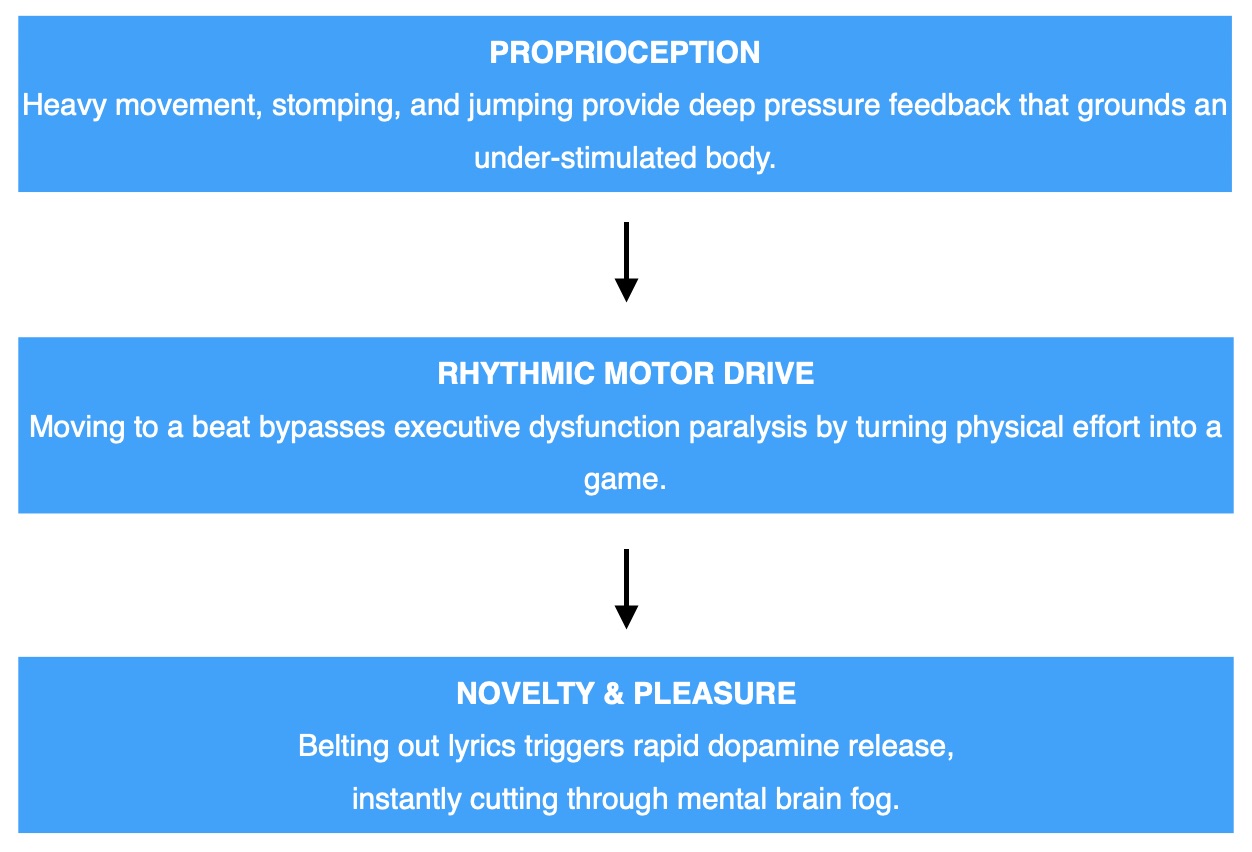
If singing is the vocal release valve, dancing around the kitchen island is the physical one. You don’t need choreography; in fact, the more unstructured and unpolished your movement is, the better it is for your mind.
3. AUDHD & THE POWER OF UNMASKED STIMMING
If you are AuDHD, your brain exists in a unique interplay between ADHD's craving for novelty/intensity and Autism's need for routine, deep immersion, and sensory regulation.
Many neurodivergent adults spend their entire day masking—suppressing natural twitches, controlling their tone of voice, hiding fidgeting, and trying to pass as "calm and collected". This constant self-monitoring drains huge amounts of cognitive energy.
SINGING AND DANCING AS "ECHOLALIA" & "STIMMING" (SELF-STIMULATING BEHAVIOUR-REPEATED MOVEMENTS)
-
- Echolalia: Repeating catchy phrases, lyrics, or sound effects over and over is a natural vocal stim. Screaming a specific line in a song because the vocal cadence feels good in your mouth is pure auditory joy.
- Full-Body Stimming: Flailing your arms, rhythmically jumping, or head-banging in the kitchen is unmasked physical stimming. It releases pent-up emotional and physical energy stored in the body throughout the day.
When you close the car door or turn up the speakers in the kitchen, you enter a zero-judgment zone. Singing off-key isn't a failure to hit pitch; it's a refusal to mask.
4. THE POWER OF BEING OFF-KEY AND OUT OF RHYTHM
THE MAGIC OF "LOW-STAKES" PLAY
Here’s the secret: the lack of perfection is actually where the therapy lives.
When you sing in a choir or dance in a class, there’s a subtle layer of performance anxiety: Am I in tune? Am I on beat? Am I keeping up?
When you’re in your car or cooking dinner, there is no audience. Being wildly off-key forces you to abandon self-criticism and step into pure expression. It breaks through emotional numbness, releases bottled-up anger or sadness, and brings you directly into the present moment.
ADHD and AuDHD brains are frequently bogged down by perfectionism, rejection sensitivity dysphoria (RSD), and the pressure to perform.
When you intentionally sing badly, you bypass the inner critic.
It is pure, unadulterated play—something adult brains desperately need, but rarely make room for.
HOW TO BUILD A "KITCHEN & CAR PLAYLIST" - FOR A NERVOUS SYSTEM RESET.
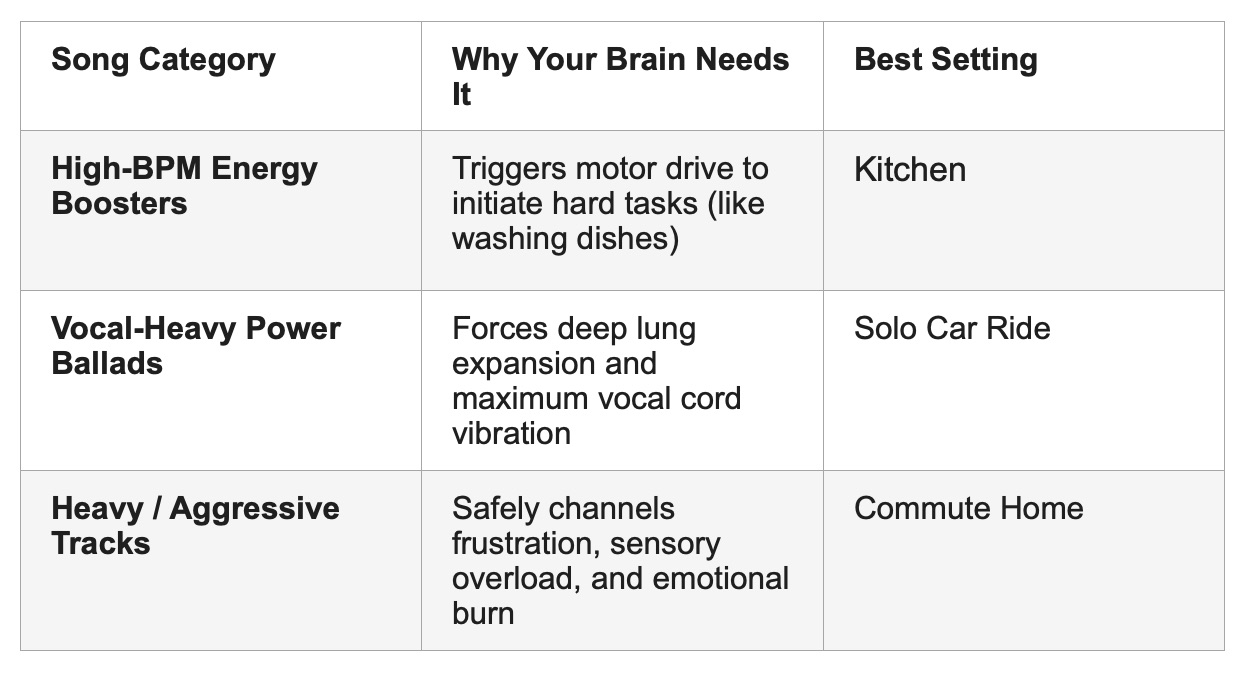
You don't need an elaborate routine to get the mental health benefits of music and movement. Here’s how to make it an everyday aid and turn your commute or chores into a brain-regulation tool:
-
- Create a "State-Shift" Playlist: Build a 3-to-5 song playlist reserved strictly for bad days, high-stress moments, or low-motivation slumps. Choose tracks with a strong rhythm and vocals you love to sing along with.
- Lower the Barrier to Entry: Start small. If you're feeling overwhelmed while preparing a meal or driving home from a long workday, turn up the volume by just two notches and let yourself sway or hum.
- Embrace the Absurdity: If you feel silly, lean into it. The moment you laugh at yourself, your brain shifts out of defence mode and into play mode.
You can also try building a Reset Playlist using these guidelines:
THE BOTTOM LINE
The next time you find yourself using a spatula as a microphone or blasting classic rock at a red light, don't feel embarrassed. Roll up the windows, turn up the stereo, and let yourself sing! You aren't being silly—you’re actively tuning your neurotransmitters, regulating your vagus nerve, and giving your neurodivergent brain the exact release it needs.
Keep singing and dancing like no ones watching! Your brain will thank you for it!
Go Mad Music ® 2026